Snowflake Architecture
AIQu VEIL is a Snowflake Native App that trains deterministic autoencoders on consumer-specified feature columns and applies the trained encoder transparently via column masking policies. All processing happens inside the consumer’s Snowflake account. No data leaves the account. No external network calls are made.
The app runs two SPCS services (encoding and training), uses three schemas (versioned, runtime, persistent state), and exposes no public endpoints.
Query-time encoding
Section titled “Query-time encoding”When a consumer queries a protected column, the masking policy transparently replaces raw features with encoded vectors. The call chain: masking policy calls core.encode(), which delegates to app_runtime.encode() (service-bound), which routes to the encoding service over internal SPCS HTTP.

The encoding service loads ONNX models from an internal stage. Models are never downloaded from external sources. A consumer sees encoded vectors; the raw features are never returned to non-bypass roles.
Training
Section titled “Training”Training starts when a consumer calls train_encoder() directly or when a schedule fires via schedule_training(). The procedure inserts a job record and calls the training service via a service-bound function. The training service reads feature data through a warehouse, trains an autoencoder, exports the ONNX model to the internal stage, and signals the encoding service to reload.
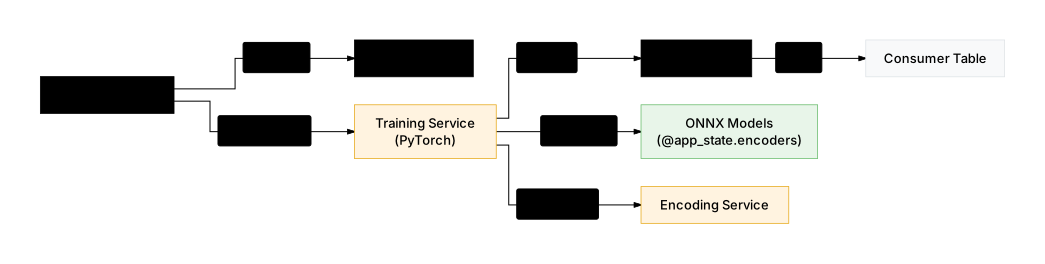
Training runs on CPU by default. GPU acceleration is optional and requires explicit configuration. The training service authenticates to Snowflake via the SPCS OAuth token. The reload signal uses a bearer token for inter-service authentication.
Model architecture
Section titled “Model architecture”The autoencoder uses residual fully-connected blocks with Z-score normalization baked into the ONNX graph. Normalization parameters are computed during training and stored as ONNX constants, so no preprocessing is required at query time.
Training parameters:
- Loss: MSE reconstruction + L2 regularization
- Optimizer: AdamW (1e-3 LR, cosine decay)
- Gradient clipping: max_norm=5.0
- Early stopping: 10 epochs patience
After training, only the encoder half is exported. The decoder is discarded. The exported model has a dynamic batch size axis for efficient inference.
Null handling
Section titled “Null handling”| Condition | Action |
|---|---|
| Column has some nulls | Impute with column mean, log count |
| Column is >50% null | Warn (training continues) |
| Column is 100% null | Error (cannot compute mean or std) |
Compute modes
Section titled “Compute modes”| Mode | Pool family | When to use |
|---|---|---|
| CPU (default) | CPU_X64_XS | Simpler models, smaller datasets, universal availability |
| GPU (opt-in) | Region-dependent | Larger datasets, faster training |
Tested GPU families:
| Cloud | Family | GPU |
|---|---|---|
| AWS | GPU_NV_S | A10G 24GB |
| Azure | GPU_NV_SM | A10 24GB |
| GCP | GPU_GCP_NV_L4_1_24G | L4 24GB |
GPU mode selection uses SHOW COMPUTE POOL INSTANCE FAMILIES at runtime. If no tested family is available in the consumer’s region, GPU mode is rejected with a clear error.
Deployment layout
Section titled “Deployment layout”The app creates three schemas inside the app database.
| Schema | Type | Contents |
|---|---|---|
core | Versioned | Procedures, wrapper functions, consumer-facing views |
app_runtime | Non-versioned | Services, service-bound functions, masking policies, feature views |
app_state | Non-versioned | Encoder registry, training jobs, configuration, ONNX model stage |
core is replaced on upgrade. Services and masking policies live in app_runtime because Snowflake prohibits these object types in versioned schemas. Feature views live in app_runtime by design: they are app-owned rather than created in consumer schemas, avoiding consumer-side CREATE VIEW privileges. The core.encode() wrapper delegates to the service-bound function in app_runtime.
Information flow
Section titled “Information flow”| Flow | Source | Destination | Mechanism |
|---|---|---|---|
| Query-time encoding | Consumer query on masked column | Encoding service | Masking policy calls core.encode(), delegates to app_runtime.encode() (service-bound), calls encoding service via HTTP |
| Training data read | Consumer source table | Training service | SELECT via warehouse, scoped to consumer-specified table |
| Model storage | Training service | Internal stage | ONNX file written to @app_state.encoders via volume mount |
| Model reload | Training service | Encoding service | HTTP POST /reload with bearer token |
| Masking policy attach | protect_column procedure | Consumer column | ALTER via app-owned policy on app-owned view |
Container images
Section titled “Container images”| Image | Base | Purpose | GPU |
|---|---|---|---|
veil-snowflake-service | ubuntu:24.04 | ONNX Runtime inference (Rust) | No |
veil-training-service-cpu | python:3.12-slim | Autoencoder training (default) | No |
veil-training-service | nvcr.io/nvidia/pytorch:24.12-py3 | Autoencoder training (GPU mode) | 1 NVIDIA GPU |
All three images run as non-root users (UID 1000).
Model lifecycle
Section titled “Model lifecycle”Publishing. The training service writes to a temp file, then copies to the active path. Registry entry is created only after the live file is confirmed on disk.
Archiving. When retraining an existing encoder, the current model is archived as <encoder>_vN.onnx before the new version is published.
Loading. The inference service loads only active models (files without the archive suffix). On /reload, models whose stage files no longer exist are evicted.
Deletion. Hard delete removes the active model file, all archived versions, the feature view, the feature function, and the registry entry.
Concurrency
Section titled “Concurrency”One training job runs at a time across all encoders. A database-level slot lock enforces this. The lock is acquired atomically via UPDATE on a single-row table and released when the job completes, fails, is cancelled, or the training service encounters a startup error.
Performance
Section titled “Performance”| Use case | Approach |
|---|---|
| Ad-hoc queries | Use masking (transparent) |
| Dashboards | Use masking (small result sets) |
| ML training export | Precompute to table, then export |
| Real-time serving | Query protected view directly |
The encoder service batches all rows in a single HTTP request (1 request with 1000 rows, not 1000 separate requests).